How to Choose a BOPP Slitting Machine for Your Films
2026-11-04
A material-first guide to BOPP slitting machine selection: four decision conditions (finished roll size, lamination or aluminium layer, speed and capacity tier, floor space) compared across three verified KESHENG models, with a pre-order confirmation checklist.
Selection Guide
BOPP film splits differently depending on what else is in the web, how large a finished roll your customers accept, and how much floor you have. This guide compares three KESHENG BOPP slitting machine configurations — using the manufacturer's listed specifications — against those four conditions, so you can match a machine to your film rather than to a brochure headline.
Key takeaways
- Finished roll diameter is the first filter: 600 mm rewind and 800 mm rewind are not interchangeable for buyers shipping large rolls.
- If the web includes lamination, PET or BOPA, check the model's stated material list before ordering; if it includes an aluminium or metallized layer, a different configuration applies.
- Speed tiers are 600 m/min and 800 m/min in the listed range; footprint differences of up to 0.75 m in length matter in existing buildings.
- Send a material sample, target roll diameter and a floor plan before the quotation is finalised.
Why BOPP needs a material-first selection
A BOPP film slitting machine is usually bought for one of three jobs: slitting plain BOPP into finished rolls, slitting BOPP as part of a laminated structure (for example BOPP combined with PET or BOPA for flexible packaging), or handling webs that carry an aluminium or metallized layer. Those three jobs do not resolve to the same machine, and the differences show up in the material applicability list, the rewind diameter and the speed and footprint of each model.
That is why starting from a model number is the wrong order. Start from the film: what the web contains, what finished roll size your market asks for, and what your building can take. Then read the specifications against those answers.
The four decision conditions
1. Finished roll size
Rewind diameter sets what you can deliver without secondary handling of small rolls. In the listed range, two configurations differ here: the KWF-K has a 600 mm rewind, while the KFA-800B rewind reaches 800 mm, and the KGF-S800 offers 600 mm or 800 mm rewind as an option. If your buyers order large finished rolls, 800 mm rewind capability is a specification to look for, not an upgrade to decide later.
2. Whether the film is laminated or carries an aluminium layer
Plain BOPP and a laminated BOPP structure are different inputs. The KGF-S800 lists lamination film, PET, BOPP and BOPA among its applicable materials, which makes it the configuration to examine when the web is a composite rather than a single BOPP layer. The KWF-K is listed for various plastic films and composite films and is described as hot-selling in the flexible packaging industry, so it covers composite work as well.
Aluminium is a boundary case. If the film contains a pure aluminium or soft-aluminium composite layer, or a metallized layer, the relevant configuration is the KWF-E, listed for pure aluminium, soft-aluminium composite, metallized film and BOPP/CPP/PET/PE at 500 m/min. The KWF-E is noted here only to mark where the material boundary sits; it is not the subject of this comparison.
3. Speed and capacity tier
Listed speeds in this group are 600 m/min for the KWF-K and KFA-800B, 600/800 m/min for the KGF-S800, and 500 m/min for the KWF-E boundary configuration. The choice between 600 and 800 m/min should follow your actual order profile and downstream handling capacity. Slitting speed alone does not define throughput; it has to be read alongside the operating width and the rewind size you are running.
4. Floor space
Footprints differ by up to 0.75 m in length and about 0.3 m in width and height across these models, which is enough to decide whether a machine fits an existing line or requires layout changes:
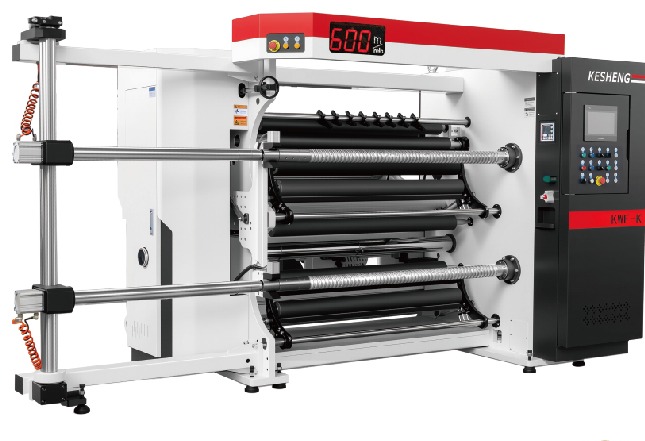
- KWF-K: 4.1 × 2.3 × 2.1 m
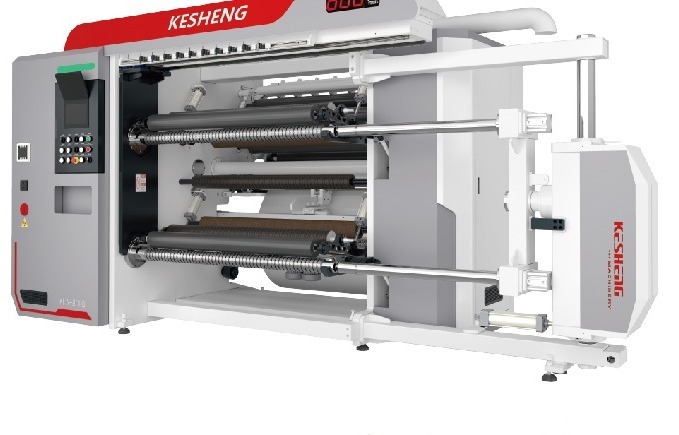
- KFA-800B: 4.58 × 2.55 × 2.31 m
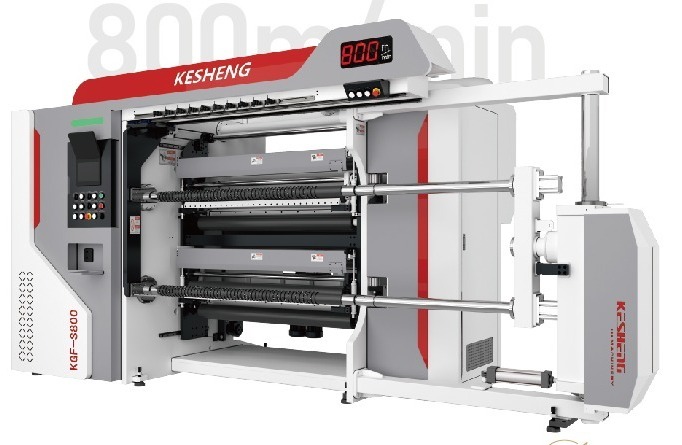
- KGF-S800: 4.85 × 2.50 × 2.41 m
Measure the intended position, including clearance for loading and unloading, before choosing on capability alone. The unloading rack is optional on these machines and can be paired with a robotic arm, which adds its own space requirement.
Cross-model comparison of listed specifications
| Specification | KWF-K | KGF-S800 | KFA-800B |
|---|---|---|---|
| Stated material applicability | Various plastic films and composite films; hot-selling in flexible packaging | Lamination film, PET, BOPP, BOPA | Lamination film, PET, BOPP and similar webs |
| Unwind diameter | 800 mm | 1000 mm | 1000 mm |
| Working width | 1300 mm | 1300 mm | 1300 mm |
| Rewind diameter | 600 mm | 600 / 800 mm (optional) | 800 mm |
| Speed | 600 m/min | 600 / 800 m/min | 600 m/min |
| Footprint (L × W × H) | 4.1 × 2.3 × 2.1 m | 4.85 × 2.50 × 2.41 m | 4.58 × 2.55 × 2.31 m |
| Unloading rack | Optional; robotic arm available | Optional; robotic arm available | Optional; robotic arm available |
Selection paths by scenario
Scenario A — Plain BOPP, standard finished rolls, existing building
If the web is plain or lightly converted BOPP and your customers accept 600 mm finished rolls, the KWF-K is the smallest-footprint option in this group at 4.1 × 2.3 × 2.1 m, with 800 mm unwind, 1300 mm working width and 600 m/min. Its stated coverage of plastic and composite films means it is not limited to a single BOPP structure. Check the finished roll requirement first: if 600 mm is below what your market orders, this path closes.
Scenario B — Laminated BOPP or multi-material webs
When the BOPP is one layer in a laminated structure and the line also runs PET or BOPA, the KGF-S800 is the model whose stated material list names those films. It pairs a 1000 mm unwind and 1300 mm working width with 600 or 800 m/min and a 600 or 800 mm rewind option, so one machine can serve more than one finished roll class. The trade-off is footprint: at 4.85 × 2.50 × 2.41 m it is the largest of the three, and the larger unwind diameter adds to the space and handling plan.
Scenario C — Large finished rolls as the priority
If large-diameter finished rolls are the commercial requirement, the KFA-800B is built around that: 800 mm rewind with a 1000 mm unwind and 600 m/min, at 4.58 × 2.55 × 2.31 m. Its listed materials cover lamination film, PET and BOPP and similar webs — the mainstream BOPP-line materials — so the comparison with the KGF-S800's optional 800 mm rewind should be made on your other materials, unwind needs and speed target, not on rewind diameter alone.
Scenario D — Aluminium or metallized layer present
If the film carries a pure aluminium or soft-aluminium composite layer, or a metallized layer, the material leaves the scope of the three models above and the KWF-E is the corresponding configuration, listed at 500 m/min for those materials alongside BOPP, CPP, PET and PE. State the layer structure explicitly in your enquiry so the recommendation is made against the actual web.
Before you place the order
Three items resolve most of the remaining uncertainty, and all three are ordinary information a supplier needs anyway.
- Material sample and layer structure. Send an actual sample of each film you intend to run, with the structure written out — for example plain BOPP, BOPP/PET lamination, or a metallized layer. The material applicability list is the first filter, and a sample is what confirms it.
- Target finished roll diameter and core specification. Say whether 600 mm or 800 mm finished rolls are required, and for which share of your orders. This decides between rewind configurations rather than leaving it to the quotation stage.
- Building dimensions and layout. Provide the machine position, available height and clearance for loading and unloading, plus whether an unloading rack and robotic arm are planned. The footprints above range from 4.1 m to 4.85 m in length; a layout drawing is the cheapest way to catch a mismatch.
Two further points are worth confirming in writing because they affect the delivered configuration rather than the model choice: whether the rewind diameter and speed tier quoted match the option you selected (the KGF-S800 in particular is offered in 600/800 variants), and how the unloading arrangement and robotic arm interface with your existing handling.
Matching a BOPP slitting machine to the film, not the other way round
The practical sequence is short: define the web structure, define the finished roll, define the capacity tier, then check the footprint. Applied to the listed range, that sequence points to the KWF-K for compact, mixed plastic and composite film work at 600 mm rewind, the KGF-S800 for laminated and multi-material lines that need a 1000 mm unwind and an optional 800 mm rewind, and the KFA-800B where 800 mm finished rolls are the priority. Webs with an aluminium or metallized layer sit outside this group and belong with the KWF-E configuration.
None of the three is a universal answer. Each one is the right answer under a specific combination of material, roll size and floor space — which is exactly the combination worth writing down before you ask for a quotation.
Specifications in this article are as listed for each model and describe the configuration offered, not tested performance. Options, including unloading racks and robotic arms, vary by order and should be confirmed with the supplier before purchase.