Sourcing a Slitting Machine from China: What to Verify Before You Order
2026-11-04
A practical pre-order checklist for overseas buyers evaluating a slitting machine supplier in China: how to check certificates and company identity, compare quoted specifications line by line against the machine model, run a remote or video inspection, and confirm after-sales, spare parts and shipping terms before you commit.
Sourcing Guide
Buying a slitting machine from China is not a problem of finding a listing — it is a problem of verifying a supplier and a quoted specification before money moves. This guide gives you a checkable sequence: what to confirm about the company and its certificates, how to read a quotation line by line against the machine model, what a video inspection should show, and which after-sales and shipping points belong in the order confirmation.
- Why a verification checklist matters
- Supplier identity and certificate checks
- Specification matching, line by line
- Video and remote inspection points
- After-sales, spare parts and shipping
- Pre-order confirmation list
Why a verification checklist matters
Slitting machines are built around your material and your finished roll requirements. A quotation that names a model but does not tie it to unwind diameter, working width, rewind diameter and line speed leaves you comparing incomplete information. The same applies to the supplier: a company name on a website is not the same as a legal entity you can inspect, and a certificate image is not the same as a certificate whose scope covers what you are buying.
A checklist does not make the decision for you. It makes the gaps visible while you still have room to ask questions — before a deposit, before production, before shipment.
Supplier identity and certificate checks
Confirm the legal entity
Start with the exact registered company name and confirm it matches the quotation, the proforma invoice and the bank beneficiary. JIANGYIN KESHENG MACHINERY CO.,LTD is a slitting machine manufacturer; ask for the business licence and check the name character by character against the contract documents. Any mismatch between the trading name, the invoice issuer and the bank account is a point to resolve in writing before payment.
Certificates: ask for the original and check the scope
The company's certificate page displays a TÜV CE certificate and an ISO 9001 certificate. Request copies and compare them with the originals or with the issuing body's records. Two details matter more than the logo:
- Scope and subject. A management-system certificate covers the certified entity and its stated scope; it does not by itself certify every machine model. Check that the entity named on the certificate is the entity you are contracting with.
- Validity and version. Certificates have issue and expiry dates. An expired or superseded copy is not evidence of current certification.
A catalogue specification and a certificate are different kinds of evidence. The catalogue tells you what the manufacturer lists for a model; the certificate tells you what a certification body assessed. Neither is a test report for your specific machine, so if a compliance document is a condition of your purchase, state that requirement and confirm how it will be supplied with the order.
Specification matching: line by line
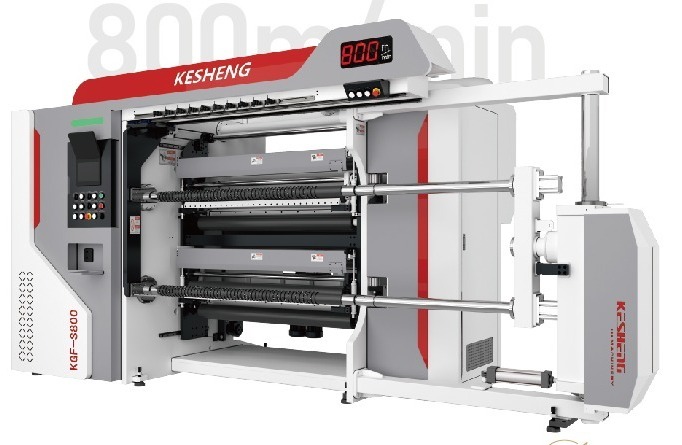
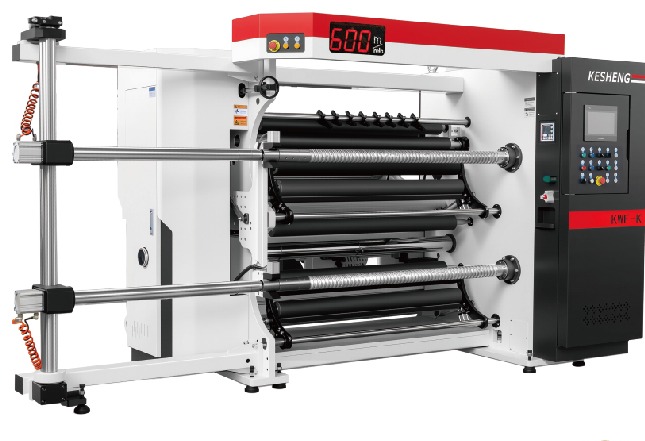
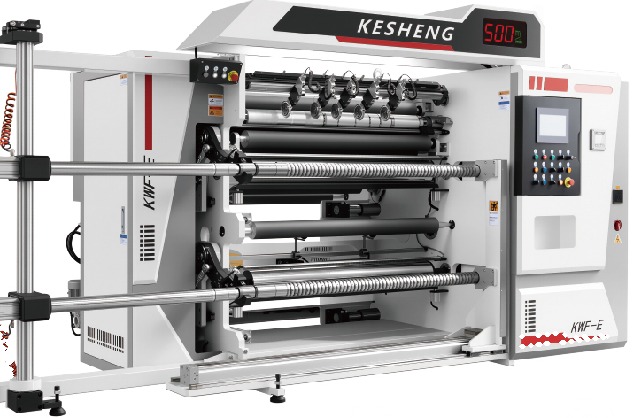
The most common pre-order error is accepting a model name as a specification. Take the quotation and put it beside the model data, one parameter per row. Below is how that comparison looks using the manufacturer's listed data for three KESHENG models.
| Parameter | KGF-S800 | KWF-K | KWF-E |
|---|---|---|---|
| Unwind diameter | 1000 mm | 800 mm | 800 mm |
| Working width | 1300 mm | 1300 mm | 1300 mm |
| Rewind diameter | 600 / 800 mm | 600 mm | 600 mm |
| Line speed | 600 / 800 m/min | 600 m/min | 500 m/min |
| Footprint (L × W × H) | 4.85 × 2.50 × 2.41 m | — | — |
| Listed material suitability | Lamination film, PET, BOPP, BOPA | Plastic films and laminating films | Pure and soft aluminium foil laminates, metallised film, BOPP, CPP, PET, PE |
| Unloading rack | Optional, interchangeable mechanical arm | Optional, interchangeable mechanical arm | Optional, interchangeable mechanical arm |
Values as listed on the manufacturer's product pages. “—” means the figure was not listed in the source data; ask the supplier if you need it. Line speed is a listed machine rating, not a promised output for your material and running conditions.
Which rows to read first
Three rows decide whether the machine fits your process at all:
- Unwind diameter against the roll size you receive from your upstream process. A 1000 mm unwind on the KGF-S800 and an 800 mm unwind on the KWF-K or KWF-E are not interchangeable positions if your incoming rolls exceed 800 mm.
- Working width against the widest web you intend to run and the slit-width pattern you need. All three models list 1300 mm.
- Rewind diameter and line speed against your finished roll spec and your required throughput. Note that the KGF-S800 lists two figures for rewind diameter and two for speed; ask which configuration the quotation refers to rather than assuming the higher figure applies.
Material suitability is the next check. If you run metallised film or aluminium foil laminates, the KWF-E listing names those materials; if you run BOPA or lamination film, the KGF-S800 listing names those. Match the list on the supplier's page to your actual incoming substrate, then ask what changes — blade arrangement, tension control, rewind shaft type — your material requires.
Video and remote inspection points
If travel is not practical, a live video call is more useful than a gallery of edited photos, because you can ask the camera to move and stay on a component. Agree the agenda in advance and record the call. Ask to see:
- The nameplate or model marking on the machine being offered, so the unit on camera can be tied to the quotation and the contract.
- Unwind and rewind stations — shafts, chucks and the loading arrangement. If you ordered the optional unloading rack, confirm whether it is fitted and whether the interchangeable mechanical arm is included.
- Slitting section — the blade holder type and how blades are positioned for the slit pattern you specified.
- Tension and control panel — the control interface language and the parameters the operator sets.
- Run demonstration with the material closest to your substrate, with the parameters shown on the panel.
State in advance what the demonstration must show. A machine running on a different film confirms that the drive and controls work; it does not confirm performance on your material. How the supplier responds to a specific, checkable request tells you more than a general assurance.
After-sales, spare parts and shipping
These items are commercially decisive and are frequently left out of the quotation. Put each one in the order confirmation in writing.
After-sales
- Who provides technical support after delivery, through which channel, and in which language.
- Whether installation and commissioning support is included, optional, or remote, and what it covers.
- Operator training: on site, remote, or documentation only.
Spare parts
- The consumable and wear list for your configuration — blades, shafts, bearings, belts — with part numbers tied to the delivered model.
- Which spares are recommended to ship with the machine.
- The stated lead time for reordering each item, in writing.
Shipping and acceptance
- Packing method, and whether the machine travels assembled or in sections that require site reassembly.
- Which Incoterm applies, and where responsibility passes.
- The shipping dimensions and weight, so you can check door openings, crane capacity and floor loading at your site before the machine arrives.
- Warranty terms: duration, what is covered, and how a claim is made.
- Pre-shipment inspection and the documents supplied with the shipment.
Do not accept a verbal delivery date. Ask for the committed date and the conditions attached to it in the order confirmation, and treat any date not written into the contract as unconfirmed.
Pre-order confirmation list
- Legal company name matches the quotation, invoice and bank beneficiary.
- CE and ISO 9001 certificate copies obtained; entity, scope and validity checked against the issuing body's records.
- Model number on the quotation matches the model data; every parameter row compared, including the configuration behind dual rewind-diameter or speed figures.
- Unwind, working width, rewind and speed checked against your actual rolls, slit pattern and throughput requirement.
- Material suitability confirmed for your substrate, with any required machine changes stated in writing.
- Optional unloading rack and interchangeable mechanical arm confirmed as included or excluded.
- Video inspection completed and recorded; nameplate, stations, slitting section and run demonstration seen.
- After-sales channel, commissioning support and training scope confirmed.
- Spare parts list, recommended spares and reorder lead times in writing.
- Packing method, Incoterm, shipping dimensions and weight confirmed against your site access.
- Warranty terms, pre-shipment inspection and document list confirmed.
- Delivery date written into the order confirmation with its conditions.
Working through this list before you order converts a model name and a price into a defined machine, a defined supplier and defined terms. Where an answer is missing, that is the item to resolve — not an assumption to carry into production.
Next step
Send your material types, roll dimensions, target speed and certificate requirements — the same items listed above — through the inquiry form on the KESHENG website. A configuration proposal can only be as specific as the information you provide, so submitting the completed checklist is the fastest way to a quotation you can actually compare.