
What Determines the Price of a Slitting Machine?
2026-11-04
Slitting machine price is driven by configuration, not by a single headline number. This article breaks down the six specification dimensions that separate one quotation from another — web width, speed class, rewind diameter, automation structure, optional modules and material fit — then shows how two real KESHENG models differ on those dimensions, and ends with a pre-quotation checklist buyers can send to every supplier so competing offers become comparable.
Buyer's Guide
Two suppliers can both quote a “high-speed slitting machine, 1300 mm” and return numbers that are impossible to compare. The gap is rarely about who is expensive. It is about what is inside each quote. This article breaks the slitting machine price into the configuration dimensions that actually move it, shows how two real KESHENG models differ on those dimensions, and gives you a checklist to send before anyone quotes.
In this article
Why quotations for the same machine type vary
A slitting machine is not a catalogue item with a fixed bill of materials. It is built to a specification, and the specification changes with what you are slitting, how wide the master roll is, how large the finished roll needs to be, how fast the line must run and how much of the roll handling is done by the machine versus by an operator.
That is why a first quotation often tells you more about the questions the supplier asked than about the machine itself. If one supplier quoted a fixed-shaft rewinder and another quoted a turret rewinder, the two figures describe different machines even if the title line is identical. The useful question is not “why is this one more expensive?” but “which configuration dimension differs between these two offers?”
Below, the price factors are treated as configuration dimensions you can verify on a specification sheet, not as a single “quality” verdict. The same machine family can be built at different configuration levels, and each level carries its own quotation structure.
The six configuration dimensions that decide the price
1. Web width and machine frame
The width the machine is built to handle sets the frame, the shafts, the guiding system and the number of slitting positions. Wider machines carry heavier rolls, so the frame and shaft sizing grow with the width. Confirm the maximum web width you need to run, because that number sizes most of the structure around it.
2. Speed class
Speed class is a design target, not a dial setting. Higher speed classes affect drive sizing, tension control response, vibration behaviour of the shafts and the balancing of rotating parts. A machine rated to a higher speed class is built differently from one rated lower, even when both use the same web width.
3. Rewind diameter
Finished roll diameter determines the size of the rewind shafts, the loading on the winding arms and the amount of floor space needed for roll removal. A larger rewind diameter means larger rolls and typically a heavier finished-roll handling task — which connects directly to the automation question below.
4. Automation structure
This is the largest visible divider between two quotations. A conventional single-shaft or fixed-shaft rewinder requires the line to stop to remove finished rolls. A turret rewinder carries multiple independent rewind shafts on a rotating turret, so finished rolls can be changed without stopping production. The mechanical content of the two structures differs substantially: turret indexing, additional shafts, additional tension and lay-on control, and the control logic to coordinate them.
5. Optional modules
Roll handling is often quoted separately. Unloading racks, transfer arms and robotic roll removal are options, and each adds mechanical and control content. Whether you need them depends on finished roll diameter and weight and on how much manual handling your operators currently perform.
6. Material fit
The substrate drives the slitting method, tension range, shaft surface and guiding requirements. Films, laminated films, label stock and packaging composites have different behaviour under tension and different slit-quality expectations. A machine specified for one material family is not automatically the right specification for another, and the material list is one of the first things a serious quotation should reflect.
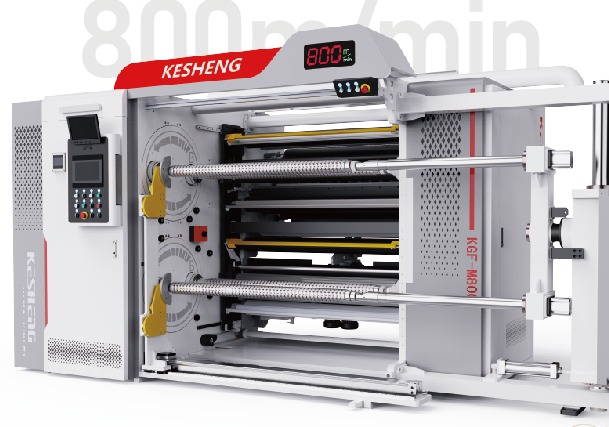
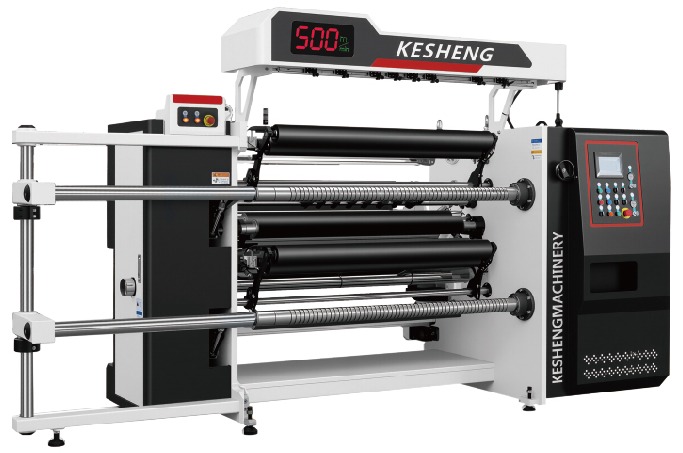
A worked comparison: KGF-M800 vs KFA-CA
Two machines from the same manufacturer, both with a 1300 mm web width, show how these dimensions separate. The comparison below uses only the listed specifications of each model; it does not assign any price to either machine.
| Configuration dimension | KGF-M800 | KFA-CA |
|---|---|---|
| Type | Fully automatic four-shaft high-speed slitting machine | Compact high-speed slitting machine |
| Unwind diameter | 1000 mm | 800 mm |
| Web width | 1300 mm | 1300 mm |
| Rewind diameter | 600 mm | 550 mm |
| Speed | 600 / 800 m/min | 500 m/min |
| Rewind structure | Four independent rewind shafts on a rotating turret; finished rolls changed without stopping the line | Not stated in the listed data; confirm the rewind structure with the supplier |
| Footprint (L×W×H) | 4.81 × 2.96 × 2.44 m | 3.7 × 2.1 × 2.1 m |
| Options | Unloading rack; robotic arm available | — |
| Materials listed | Cup-lid film, food and pharmaceutical packaging, printed labels, laminated film | Lamination film, PET, BOPP, PVC, PE |
Read the table as a set of differences in configuration level, not as a ranking. The KGF-M800 differs from the KFA-CA on several dimensions at once: a larger unwind and rewind diameter, a higher speed class, a turret rewind structure with four independent shafts, optional unloading and robotic handling, and a larger footprint that follows from all of the above. Any one of those changes the machine's build; together they mean the two models sit at different configuration levels and are quoted on different structures.
The KFA-CA is the more compact of the two, with a smaller footprint and a lower speed class. For a buyer whose finished-roll diameters and line speed fit within those values, it represents a different point on the same trade-off curve rather than a lesser version of the M800.
The practical point: if your quotation requests did not distinguish turret versus conventional rewinding, or 600 mm versus 550 mm rewind diameter, or whether an unloading rack is included, then the two offers you receive are not describing the same machine, and their prices cannot be lined up side by side.
What to confirm before you request a quotation
Send the same information to every supplier. The list below is written so it can be copied into an enquiry directly.
Material and product
- The substrate or substrates to be slit, and whether the line will run more than one material family
- Master roll width and the slit widths you need to produce
- Whether the finished product is a printed label, a packaging film or a laminated composite
Roll dimensions
- Maximum unwind roll diameter you will load
- Required finished rewind diameter
- Finished roll weight, if you already know it — this drives the handling decision
Speed and output target
- The line speed you need to sustain, stated as a target rather than a maximum
- How often finished rolls must be changed, and whether the line can stop to change them
Automation and handling
- Whether finished-roll changes must happen without stopping the line (this is the turret question)
- Whether unloading racks or robotic roll removal are required, or can be deferred
Site conditions
- Available floor space, including clearance for roll removal
- Power supply available at the installation point
- Access route for delivering and positioning the machine
How to make competing quotations comparable
A quotation is only comparable when it is itemised against the same specification. When you receive offers, ask each supplier to return the same table back to you, filled in, so the differences are visible line by line:
- Base machine specification — web width, unwind diameter, rewind diameter, speed class, rewind structure.
- Included options — unloading rack, robotic arm, and anything else bundled into the figure.
- Excluded items — what is not in the price and would be added later.
- Material list the quote is based on — the specification should name the substrates it was built around.
Where a supplier's line disagrees with yours, that disagreement is the conversation to have. A difference in rewind structure or rewind diameter explains a difference in quotation structure; it does not by itself tell you which machine is right for your line. That decision comes from your material, your roll sizes and your speed target — the inputs on the checklist above.
The short version: slitting machine price follows configuration. Web width sizes the frame, speed class sizes the drives, rewind diameter sizes the shafts and handling, turret structure adds independent shafts and control, options add roll-handling hardware, and material fit sets the tension and slitting specification. Fix those six inputs before you ask for numbers, and the quotations you receive will finally describe the same machine.
If you are comparing a turret machine against a conventional one, the KGF-M800 and KFA-CA pages list the full specification for each so you can check every dimension in the table above against your own requirement before the first quotation arrives.